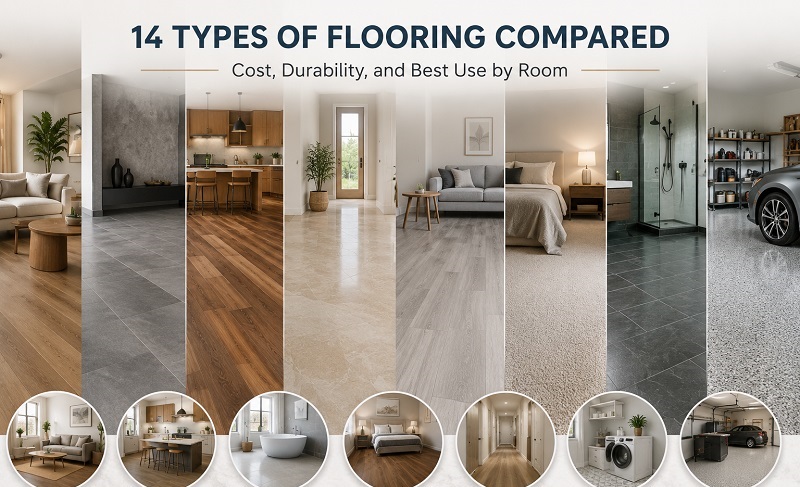
Choosing the right flooring is one of the most important decisions you make for your home. The floor covers every inch of your living space, handles all the foot traffic, and sets the tone for your entire interior design. Pick the wrong one, and you end up with scratches, water damage, or a floor that wears out in a few years. Pick the right one, and it lasts for decades while adding real value to your home.
This guide covers every major type of flooring in Dubai available today. For each one, you will find what it is made of, how much it costs, where it works best, its pros and cons, how long it lasts, and how to take care of it. You will also find comparison tables, a room-by-room guide, and tips that most other guides skip.
1. What to Think About Before You Choose Flooring
Before you look at any specific type of flooring, ask yourself a few basic questions. Your answers will guide every decision after this.
Where is the floor going? Bathrooms and kitchens need water-resistant materials. Bedrooms need comfort. Basements need moisture protection. Hallways and living rooms need durability against heavy foot traffic.
Who lives in the home? Young children and pets mean you need scratch-resistant, easy-to-clean floors. Elderly family members benefit from softer, non-slip surfaces.
What is your budget? Cost includes the material price, the underlayment, labor for flooring installation, and long-term maintenance. A cheap floor that needs replacing in five years costs more than a slightly expensive one that lasts twenty.
What look do you want? Some floors look warm and natural. Others look clean and modern. Your flooring should match your overall home design.
How much maintenance can you handle? Some floors need sealing, refinishing, or special cleaners. Others just need a quick mop.
Once you have clear answers to these questions, choosing the right flooring type becomes much easier.
2. Hardwood Flooring
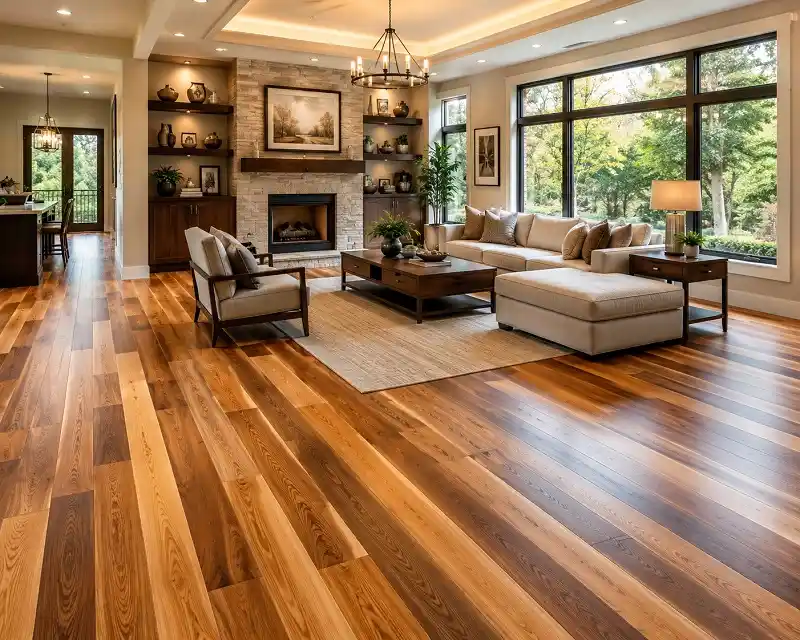
Hardwood flooring is made from solid pieces of real wood cut from trees like oak, maple, walnut, hickory, and cherry. Each plank is 100 percent natural wood from top to bottom. This is the oldest and most classic type of flooring available.
Types of Hardwood
Solid Hardwood: Each board is a single piece of wood, typically 18mm to 20mm thick. It can be sanded and refinished multiple times over its lifetime.
Prefinished Hardwood: Factory-sanded and coated with a finish before installation. Ready to walk on as soon as it is laid.
Unfinished Hardwood: Sanded and finished on site after installation, giving a more seamless look between boards.
Popular Wood Species for Hardwood Floors
| Wood Species | Hardness | Color Range | Best For |
| Red Oak | Medium | Warm reddish brown | Living rooms, bedrooms |
| White Oak | Hard | Light tan to golden | High traffic areas |
| Maple | Very Hard | Pale cream to light brown | Kitchens, hallways |
| Walnut | Medium Hard | Rich dark brown | Formal rooms |
| Hickory | Very Hard | Mixed light and dark tones | Rustic-style homes |
| Cherry | Medium | Reddish brown, darkens with age | Elegant interiors |
Hardwood Flooring Cost
| Cost Item | Price Range (per sq ft) |
| Material only | $3 to $12 |
| Installation labor | $3 to $8 |
| Fully installed | $6 to $20 |
| Full room project | $2,500 to $6,500 |
Premium exotic wood species like Brazilian cherry or teak can cost $15 to $25 per square foot for the material alone.
Benefits of Hardwood Flooring
- Timeless, classic look that never goes out of style
- Can be sanded and refinished 5 to 10 times over its life
- Adds significant resale value to your home
- Lasts 50 to 100 years or more with proper care
- Each plank is unique because it is made of natural wood
- Easy to keep clean with regular sweeping and occasional mopping
Drawbacks of Hardwood Flooring
- High upfront cost compared to most other options
- Expands and contracts with humidity changes, which can cause gaps or warping
- Not suitable for bathrooms or areas with moisture
- Can be scratched by pets, heavy furniture, or high heels
- Cannot be installed over radiant underfloor heating in most cases
- Requires periodic refinishing to maintain its appearance
Hardwood Flooring Lifespan
Solid hardwood flooring, when properly maintained, can last 50 to 100 years. Many homes over a century old still have their original hardwood floors.
Hardwood Maintenance Tips
- Sweep or vacuum daily to remove dirt and grit that scratches the surface
- Wipe up spills immediately
- Use only cleaners made specifically for hardwood floors
- Place felt pads under all furniture legs
- Refinish every 7 to 10 years, depending on wear
Best Rooms for Hardwood Flooring
Living rooms, dining rooms, bedrooms, hallways, home offices, and staircases. Avoid in bathrooms, laundry rooms, and basements.
3. Engineered Wood Flooring
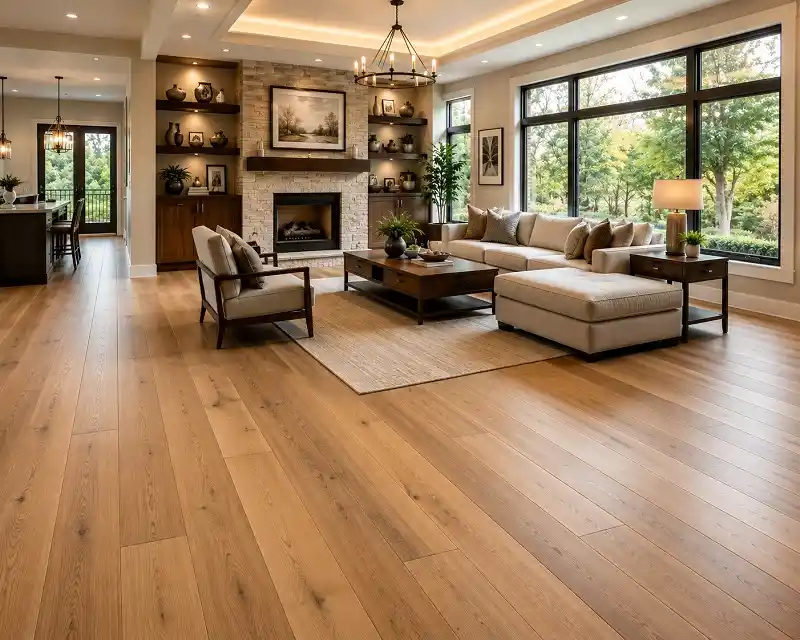
Engineered wood flooring looks exactly like solid hardwood but is built differently. It has a thin top layer of real wood called the veneer, which sits on top of several layers of plywood or high-density fiberboard pressed together. This construction makes it much more stable than solid wood.
How Engineered Wood Is Made
The core layers alternate in direction, which prevents the floor from expanding and contracting as much as solid wood. The top veneer layer is real wood, so the look and feel are identical to solid hardwood.
Engineered Wood Flooring Cost
| Cost Item | Price Range (per sq ft) |
| Material only | $3 to $13 |
| Installation labor | $2 to $6 |
| Fully installed | $5 to $19 |
Benefits of Engineered Wood Flooring
- More stable than solid hardwood in humid or warm environments
- Compatible with radiant underfloor heating systems
- Can be used in basements and over concrete slabs
- Looks identical to solid hardwood
- Can be refinished one or two times, depending on veneer thickness
- More affordable than solid hardwood in most cases
- Suitable for kitchens and other areas where solid wood cannot be used
Drawbacks of Engineered Wood Flooring
- The veneer layer is thin, so it cannot be sanded as many times as solid wood
- Some budget products use a very thin veneer that cannot be refinished at all
- Not completely waterproof; standing water will still cause damage
- Does not last as long as solid hardwood
Engineered Wood Lifespan
20 to 30 years, depending on the veneer thickness and how well it is maintained.
Best Rooms for Engineered Wood
All the same rooms as hardwood, plus kitchens, basements with good moisture control, and rooms with underfloor heating.
4. Laminate Flooring
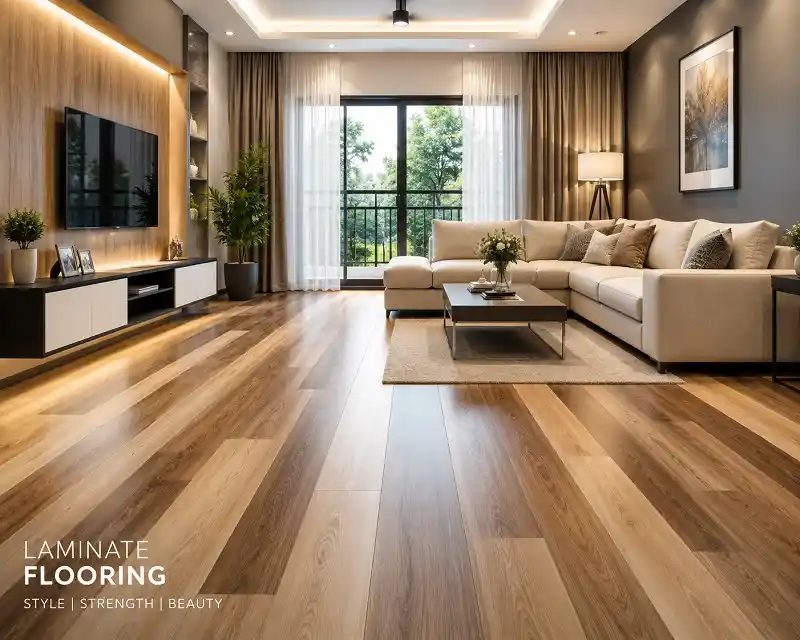
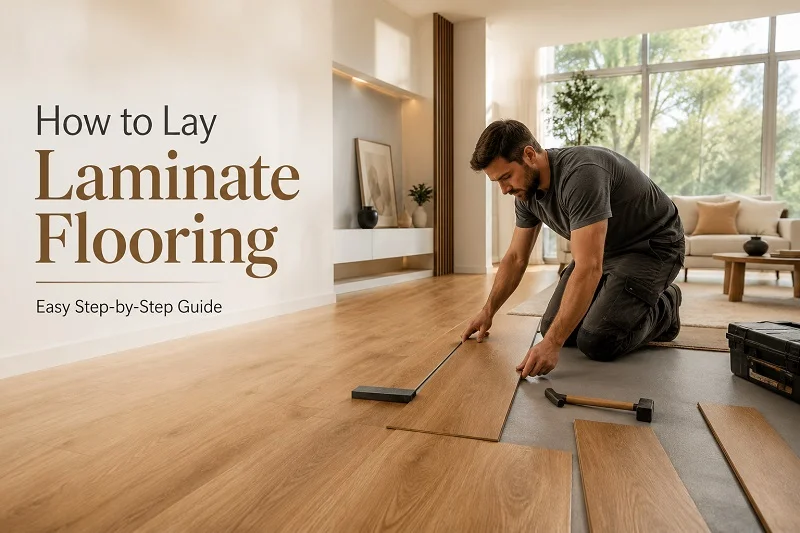
Laminate flooring is a synthetic floor covering made from four layers pressed together under high pressure. The layers are: a backing layer for stability, a core layer of dense fiberboard, a photographic image layer that can look like wood or stone, and a clear protective wear layer on top.
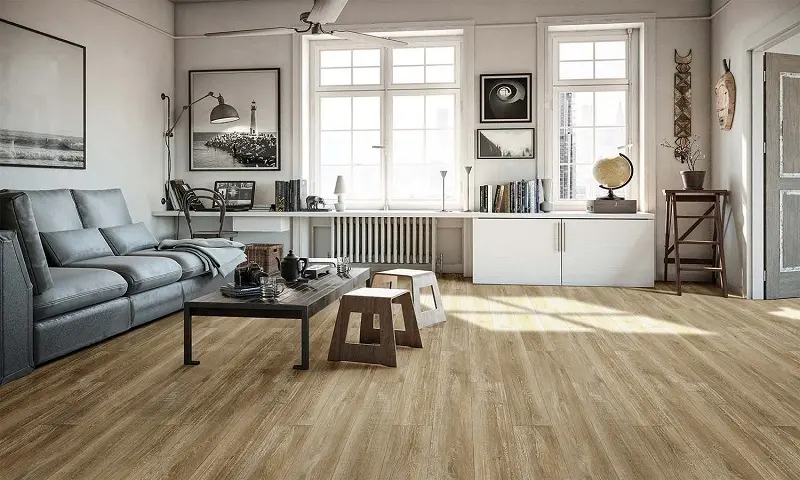
Modern laminate flooring is remarkably realistic. High-quality laminate with texture embossed to match the image can be hard to tell apart from real wood at a glance.
Laminate Flooring Cost
| Cost Item | Price Range (per sq ft) |
| Budget laminate | $1 to $3 |
| Mid range laminate | $3 to $5 |
| High quality laminate | $5 to $7 |
| Installation labor | $1 to $3 |
| Fully installed | $2 to $10 |
Benefits of Laminate Flooring
- Very affordable compared to hardwood or tile
- Easy to install with click lock planks; suitable for DIY projects
- Scratch-resistant surface holds up well in busy households
- Wide range of styles that mimic wood, stone, and tile
- Easy to clean with a damp mop
- Good resistance to fading from sunlight
Drawbacks of Laminate Flooring
- Cannot be refinished; must be replaced once the wear layer is damaged
- Not waterproof, though many newer products have water-resistant cores
- Can sound hollow underfoot without a good underlayment
- Does not feel as natural as real wood
- Low-quality products look fake, especially with repetitive patterns
Laminate Flooring Lifespan
10 to 20 years, depending on quality and foot traffic.
Laminate Maintenance Tips
- Sweep regularly to prevent grit buildup
- Clean with a damp mop and laminate-specific cleaner
- Never use steam cleaners or wet mops
- Wipe spills immediately before they seep into joints
Best Rooms for Laminate Flooring
Living rooms, bedrooms, dining rooms, hallways, and playrooms. Use water-resistant laminate for kitchens. Avoid in bathrooms unless labeled fully waterproof.
5. Luxury Vinyl Plank and Tile (LVP / LVT)
Luxury vinyl flooring is one of the fastest-growing flooring categories in the world today. It is made entirely from synthetic materials, mostly polyvinyl chloride (PVC), and is available in plank form (LVP) to look like wood and tile form (LVT) to look like stone or ceramic. High-end products are remarkably realistic.
Types of Luxury Vinyl Flooring
Luxury Vinyl Plank (LVP): Long planks that mimic hardwood. Best for living areas and bedrooms.
Luxury Vinyl Tile (LVT): Square tiles that mimic stone or ceramic. Best for kitchens and bathrooms.
WPC (Wood Plastic Composite): Has a hollow core that makes it softer and quieter underfoot.
SPC (Stone Plastic Composite): Has a denser, harder core that is more durable. Covered in its own section below.
Luxury Vinyl Flooring Cost
| Cost Item | Price Range (per sq ft) |
| Budget LVP/LVT | $1 to $3 |
| Mid range LVP/LVT | $3 to $5 |
| Premium LVP/LVT | $5 to $7 |
| Installation labor | $1.50 to $4 |
| Fully installed | $3 to $11 |
Benefits of Luxury Vinyl Flooring
- 100 percent waterproof, making it safe for all rooms, including bathrooms and basements
- Highly scratch and dent-resistant
- Comfortable underfoot, especially WPC versions
- Very easy to clean and maintain
- Wide range of realistic designs
- Good sound absorption compared to tile or hardwood
- Works over most existing floors with minimal subfloor prep
- Compatible with underfloor heating
Drawbacks of Luxury Vinyl Flooring
- Cannot be refinished; must be replaced when worn out
- Cheaper products can look plastic or artificial
- Can be dented by very heavy appliances or furniture with small contact points
- Not as environmentally friendly as natural materials
Luxury Vinyl Lifespan
15 to 25 years for quality products, with some premium versions lasting longer.
Best Rooms for Luxury Vinyl Flooring
Every room in the home. It is one of the few flooring types suitable for bathrooms, kitchens, basements, living rooms, and bedrooms alike.
6. Ceramic and Porcelain Tile Flooring
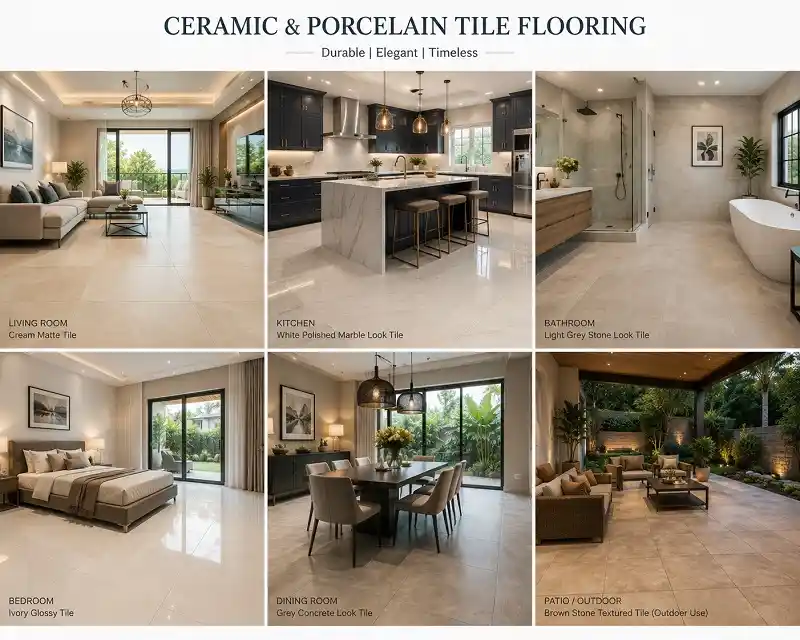
Tile flooring is one of the most durable and water-resistant options available. Ceramic tile is made from clay that is shaped and fired in a kiln. Porcelain tile is made from a denser, finer clay fired at higher temperatures, making it harder and less porous than standard ceramic.
Ceramic vs. Porcelain Tile
| Feature | Ceramic Tile | Porcelain Tile |
| Water absorption | Higher (1 to 3%) | Very low (below 0.5%) |
| Durability | Good | Excellent |
| Cost | $1 to $5 per sq ft | $3 to $10 per sq ft |
| Weight | Lighter | Heavier |
| Best for | Indoor use | Indoor and outdoor |
| DIY friendly | Moderate | More difficult |
| Chip resistance | Moderate | High |
Tile Flooring Cost
| Cost Item | Price Range (per sq ft) |
| Ceramic material | $1 to $5 |
| Porcelain material | $3 to $10 |
| Natural stone tile | $5 to $20+ |
| Installation labor | $4 to $9 |
| Grout and materials | $1 to $2 |
| Fully installed | $5 to $21+ |
Benefits of Tile Flooring
- Completely waterproof when properly sealed and grouted
- Extremely durable and long-lasting
- Scratch and stain-resistant
- Works beautifully in kitchens and bathrooms
- Available in thousands of colors, sizes, patterns, and textures
- Stays cool in summer, great for warm climates
- Low maintenance
Drawbacks of Tile Flooring
- Hard and cold underfoot, uncomfortable for long standing
- Grout lines need regular cleaning and can stain
- Can crack if something heavy is dropped on it
- Installation is time-consuming and requires skill
- Expensive to install due to labor costs
- Can be slippery when wet unless you choose a textured surface
- Not a good choice for rooms where you spend a lot of time standing, like kitchens, without anti-fatigue mats
Tile Flooring Lifespan
Ceramic tile lasts 10 to 20 years. Porcelain tile can last 50 years or more with proper care.
Best Rooms for Tile Flooring
Bathrooms, kitchens, laundry rooms, entryways, mudrooms, and outdoor patios. Choose textured tile in areas where the floor may get wet to prevent slipping.
7. Natural Stone Flooring
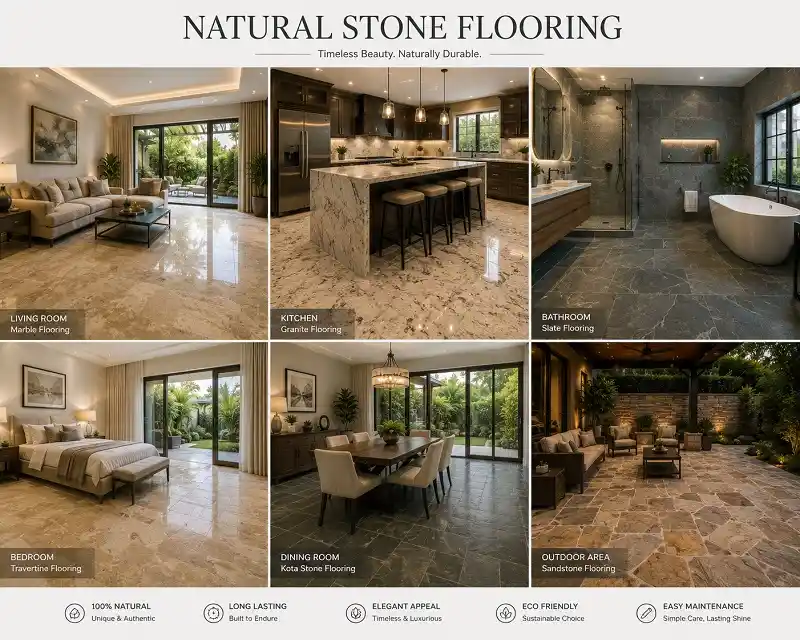
Natural stone flooring includes marble, granite, travertine, slate, limestone, and sandstone. Each piece of stone is unique, cut directly from natural quarries around the world. Stone floors add a sense of luxury and permanence that no manufactured product can fully replicate.
Types of Natural Stone for Flooring
| Stone Type | Appearance | Best Use | Relative Cost |
| Marble | White with veining, elegant | Foyers, bathrooms, luxury interiors | Very High |
| Granite | Speckled, very hard | Kitchens, entryways | High |
| Travertine | Warm beige tones, porous texture | Bathrooms, living areas | Medium High |
| Slate | Dark, earthy, textured | Entryways, outdoor areas | Medium |
| Limestone | Soft, muted tones | Living rooms, bedrooms | Medium |
| Sandstone | Warm sandy tones | Outdoor areas, casual interiors | Medium |
Natural Stone Flooring Cost
| Cost Item | Price Range (per sq ft) |
| Material only | $5 to $25+ |
| Installation labor | $7 to $15 |
| Sealing | $0.50 to $2 |
| Fully installed | $12 to $40+ |
Benefits of Natural Stone Flooring
- Unique and luxurious appearance that cannot be replicated
- Extremely long-lasting; some stone floors are hundreds of years old
- Adds significant value to a home
- Each tile is different, creating a truly one-of-a-kind floor
- Stays cool in warm climates
Drawbacks of Natural Stone Flooring
- Very expensive compared to all other flooring types
- Heavy subfloor may need reinforcement
- Porous stones like marble and limestone need regular sealing
- Hard and cold underfoot
- Can crack, chip, or scratch
- Slippery when polished or wet unless textured or honed
Natural Stone Lifespan
50 to 100 years or more when properly maintained.
Best Rooms for Natural Stone
Entryways, bathrooms, formal living rooms, dining rooms, and kitchens for granite. Marble works beautifully in bathrooms and foyers.
8. Carpet Flooring
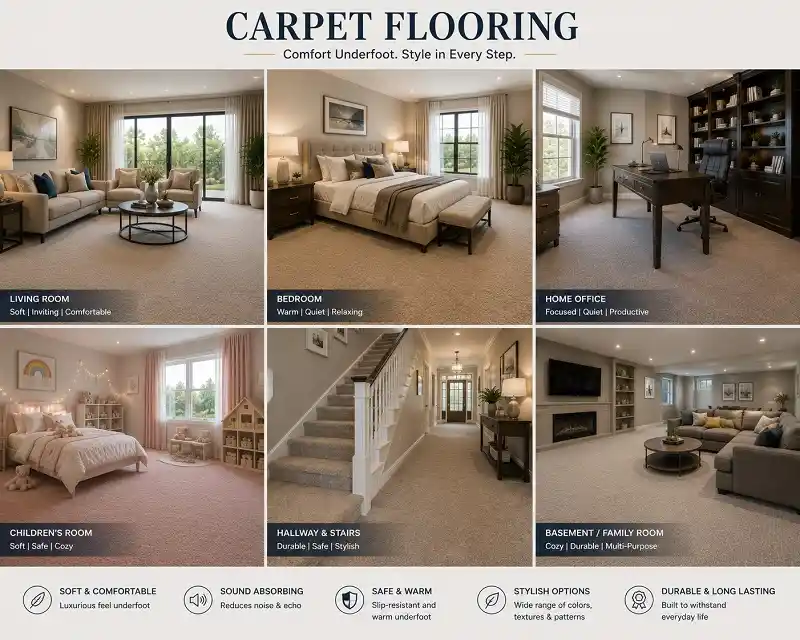
Carpet is the softest underfoot of all flooring options. It is made from fibers woven or tufted into a backing material. Modern carpet fibers include nylon, polyester, triexta, wool, and olefin. Each fiber type has different characteristics for softness, stain resistance, and durability.
Types of Carpet Fibers
| Fiber | Durability | Stain Resistance | Feel | Cost |
| Nylon | Excellent | Good | Soft | Medium High |
| Polyester | Good | Excellent | Very Soft | Medium |
| Triexta | Very Good | Excellent | Soft | Medium |
| Wool | Very Good | Moderate | Luxurious | High |
| Olefin | Moderate | Good | Coarser | Low |
Types of Carpet Styles
Cut Pile: Soft and plush, best for low traffic areas and bedrooms.
Loop Pile (Berber): More durable loops, good for hallways and stairs.
Cut and Loop Combination: Mix of textures for visual interest and durability.
Frieze: Twisted fibers that hide footprints and vacuum marks, great for busy households.
Carpet Flooring Cost
| Cost Item | Price Range (per sq ft) |
| Budget carpet | $1 to $3 |
| Mid-range carpet | $3 to $6 |
| Premium carpet (wool) | $6 to $15+ |
| Padding | $0.50 to $2 |
| Installation | $0.50 to $1.50 |
| Fully installed | $2 to $18 |
Benefits of Carpet Flooring
- The softest and most comfortable option for bedrooms and living areas
- Excellent sound absorption; reduces noise between floors
- Feels warm and cozy in cold weather
- Provides cushion and reduces the risk of injury from falls
- Very affordable for large areas
- Available in unlimited colors and patterns
- Provides insulation that helps with heating costs
Drawbacks of Carpet Flooring
- Traps dust, allergens, pet dander, and bacteria in its fibers
- Stains easily and some stains are permanent
- Requires regular vacuuming and periodic professional cleaning
- Not suitable for wet areas
- Shorter lifespan than hard flooring options
- Can look worn and dirty after a few years of heavy use
Carpet Flooring Lifespan
8 to 15 years, depending on quality and maintenance.
Carpet Maintenance Tips
- Vacuum at least twice a week in high-traffic areas
- Clean spills immediately by blotting, not rubbing
- Have the carpet professionally cleaned every 12 to 18 months
- Use rugs or runners in the highest traffic zones to reduce wear
Best Rooms for Carpet
Bedrooms, living rooms, playrooms, and stairs. Not suitable for kitchens, bathrooms, laundry rooms, or basements.
9. Bamboo Flooring
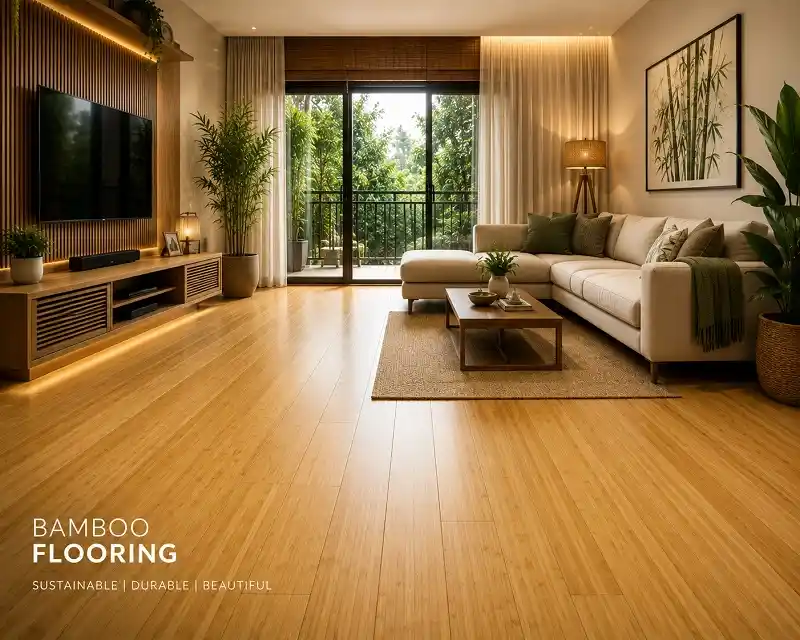
Bamboo flooring is technically not a wood floor because bamboo is a grass, not a tree. However, it looks very similar to hardwood and is processed in a way that makes it extremely hard. Strand-woven bamboo is actually harder than most traditional hardwoods.
How Bamboo Flooring Is Made
Bamboo stalks are harvested, stripped into strips, and either pressed horizontally (horizontal bamboo), vertically (vertical bamboo), or shredded and compressed under high pressure (strand woven bamboo). Strand woven is the hardest and most durable version.
Bamboo Flooring Cost
| Cost Item | Price Range (per sq ft) |
| Material only | $2 to $6 |
| Installation labor | $2 to $4 |
| Fully installed | $4 to $10 |
Benefits of Bamboo Flooring
- One of the most sustainable and eco-friendly flooring options available
- Bamboo grows to full height in 3 to 5 years, compared to 20 to 80 years for trees
- Strand-woven bamboo is harder than red oak and many other hardwoods
- Looks elegant and natural, similar to hardwood
- Relatively affordable compared to solid hardwood
- Better moisture resistance than most solid hardwoods
- Can be refinished
Drawbacks of Bamboo Flooring
- Quality varies widely between manufacturers; low-quality bamboo is soft and dents easily
- Not fully waterproof; avoid in bathrooms and basements
- Can be prone to scratches if the finish is not high-quality
- May be treated with adhesives containing formaldehyde in some budget products
- Not as widely available as other flooring types
Bamboo Flooring Lifespan
20 to 30 years for quality strand woven products.
Best Rooms for Bamboo Flooring
Living rooms, bedrooms, dining rooms, and home offices. Good for any room where you would normally use hardwood.
10. Cork Flooring
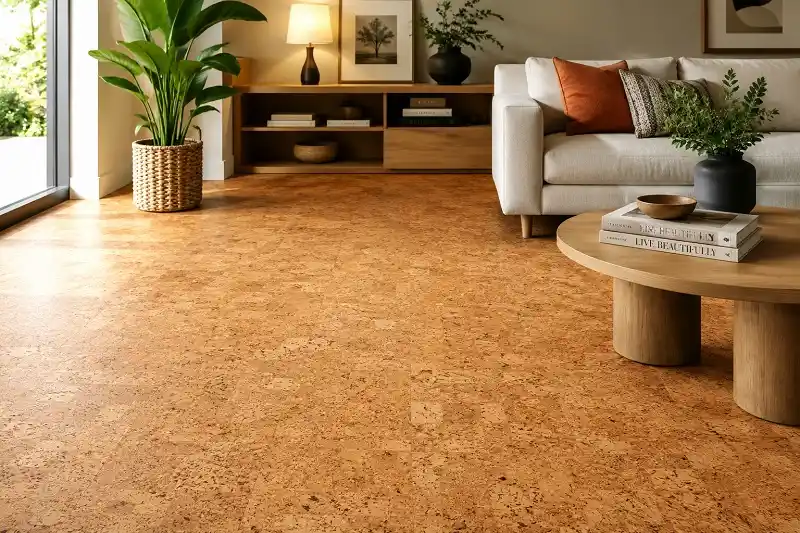
Cork flooring comes from the bark of the cork oak tree. The bark is harvested without cutting down the tree, which grows back over several years, making cork one of the most genuinely sustainable flooring materials available. Cork has a distinctive soft, springy feel that no other floor can replicate.
How Cork Flooring Is Made
Cork bark is harvested, ground into granules, and pressed with binding agents into tiles or planks. It is often sold as engineered flooring with a cork wear layer bonded to an HDF core.
Cork Flooring Cost
| Cost Item | Price Range (per sq ft) |
| Material only | $3 to $8 |
| Installation labor | $2 to $4 |
| Fully installed | $5 to $12 |
Benefits of Cork Flooring
- Soft and cushioned underfoot; easy on joints and feet
- Natural sound absorber, great for apartments and multi-story homes
- Good thermal insulator; warm underfoot in winter
- Hypoallergenic and antimicrobial properties due to the natural substance suberin
- Sustainable and eco-friendly
- Resistant to mold and mildew when properly sealed
- Good for people who spend long hours standing
Drawbacks of Cork Flooring
- Softer than other options; can be dented by furniture legs and high heels
- Must be sealed regularly to prevent water damage and staining
- Fades in direct sunlight over time
- Less durable than hardwood or tile
- Not a good choice for high-traffic entryways
Cork Flooring Lifespan
10 to 30 years, depending on quality, maintenance, and traffic level.
Best Rooms for Cork Flooring
Kitchens (where it is easy on your feet), home offices, playrooms, libraries, bedrooms, and home gyms. Its sound-dampening quality makes it ideal for apartments and condos.
11. Concrete Flooring
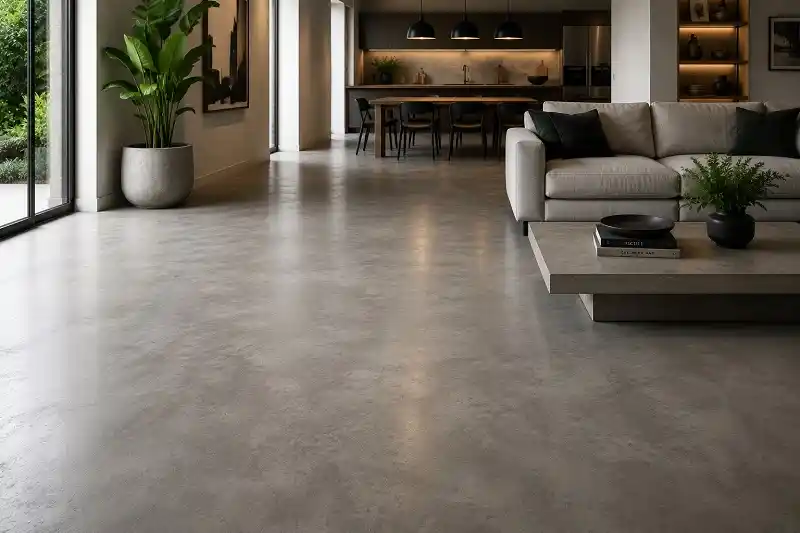
Concrete flooring is poured or existing concrete that is polished, stained, sealed, or painted to serve as the finished floor surface. It has a modern, industrial look and is extremely durable. Many commercial spaces and modern homes use polished concrete for its clean, minimalist appearance.
Types of Concrete Floor Finishes
Polished Concrete: Ground and buffed to a smooth, reflective shine. Very popular in modern and industrial style homes.
Stained Concrete: Acid stains or water-based dyes applied to create color patterns and depth.
Epoxy Coated Concrete: Resin-based coating applied on top for a seamless, ultra-durable surface. Very common in garages.
Stamped Concrete: Imprinted with patterns before it sets to mimic tile, stone, or brick.
Concrete Flooring Cost
| Finish Type | Price Range (per sq ft) |
| Basic seal over existing slab | $0.30 to $2 |
| Polished concrete | $3 to $12 |
| Stained concrete | $2 to $10 |
| Epoxy coating | $3 to $12 |
| Stamped concrete | $8 to $20 |
Benefits of Concrete Flooring
- Extremely durable and resistant to heavy traffic
- Very low maintenance once properly sealed
- Can be customized with unlimited colors and patterns
- Works indoors and outdoors
- Stays cool in hot climates
- Supports radiant underfloor heating
- Does not harbor allergens or bacteria
Drawbacks of Concrete Flooring
- Very hard and cold underfoot; uncomfortable without rugs or underfloor heating
- Needs sealing every few years to prevent staining
- Can crack over time if the foundation shifts
- Professional installation is recommended for best results
- Not ideal for upper-floor rooms due to weight and sound transmission
Concrete Flooring Lifespan
Properly sealed concrete can last the lifetime of the building, 50 years or more.
Best Rooms for Concrete Flooring
Basements, garages, living rooms, and kitchens in modern style homes, outdoor patios, and commercial spaces.
12. Linoleum Flooring
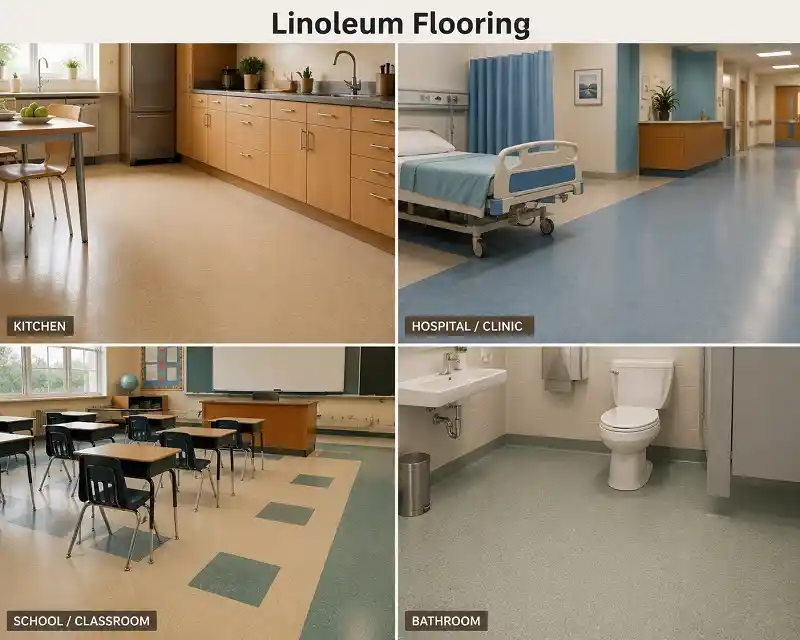
Linoleum is a natural flooring material made from linseed oil, cork dust, wood flour, and mineral pigments pressed onto a jute backing. It was extremely popular in the mid-20th century and is now making a comeback as a sustainable flooring choice. It should not be confused with vinyl, which is entirely synthetic.
Linoleum vs. Vinyl: Key Difference
Linoleum is made from natural materials and is biodegradable. Vinyl is made from synthetic PVC. Both look similar in sheet or tile form, but they have very different environmental profiles.
Linoleum Flooring Cost
| Cost Item | Price Range (per sq ft) |
| Material only | $2 to $6 |
| Installation labor | $2 to $5 |
| Fully installed | $4 to $11 |
Benefits of Linoleum Flooring
- Natural, eco-friendly, and biodegradable
- Durable and resilient; good for medium to high traffic areas
- Comfortable underfoot due to its slight cushioning
- Available in a wide range of colors and patterns
- Naturally antibacterial
- Easy to maintain
Drawbacks of Linoleum Flooring
- Needs sealing upon installation and periodic resealing
- Can be damaged by standing water if not sealed properly
- Requires professional installation for best results
- Less waterproof than vinyl
Linoleum Flooring Lifespan
20 to 40 years with proper maintenance.
Best Rooms for Linoleum Flooring
Kitchens, bathrooms, laundry rooms, and commercial spaces. Good choice for anyone who wants the look of vinyl with a more sustainable material.
13. Rubber Flooring
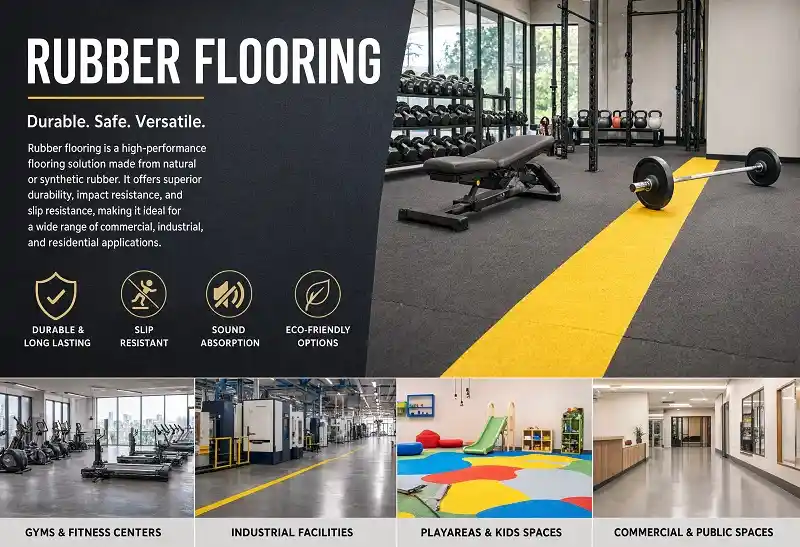
Rubber flooring is made from natural rubber, recycled tires, or synthetic rubber compounds. It is best known for its use in gyms, sports facilities, and commercial kitchens, but it is increasingly being used in home settings as well.
Rubber Flooring Cost
| Cost Item | Price Range (per sq ft) |
| Budget rubber tile | $1 to $3 |
| Mid-range rubber | $3 to $6 |
| Commercial-grade rubber | $6 to $12 |
| Installation | $2 to $5 |
Benefits of Rubber Flooring
- Excellent shock absorption; ideal for gyms and exercise areas
- Very slip-resistant even when wet
- Durable and resistant to heavy equipment and foot traffic
- Sound absorbing and vibration-dampening
- Easy to clean and maintain
- Comfortable to stand on for long periods
- Often made from recycled materials
Drawbacks of Rubber Flooring
- Industrial appearance does not suit most home living spaces
- Can have a noticeable rubber smell when first installed
- Heavier products can be difficult to install
- Not the most attractive choice for formal rooms
Best Rooms for Rubber Flooring
Home gyms, garages, basements, playrooms for children, laundry rooms, and commercial kitchens.
14. SPC Flooring (Stone Plastic Composite)
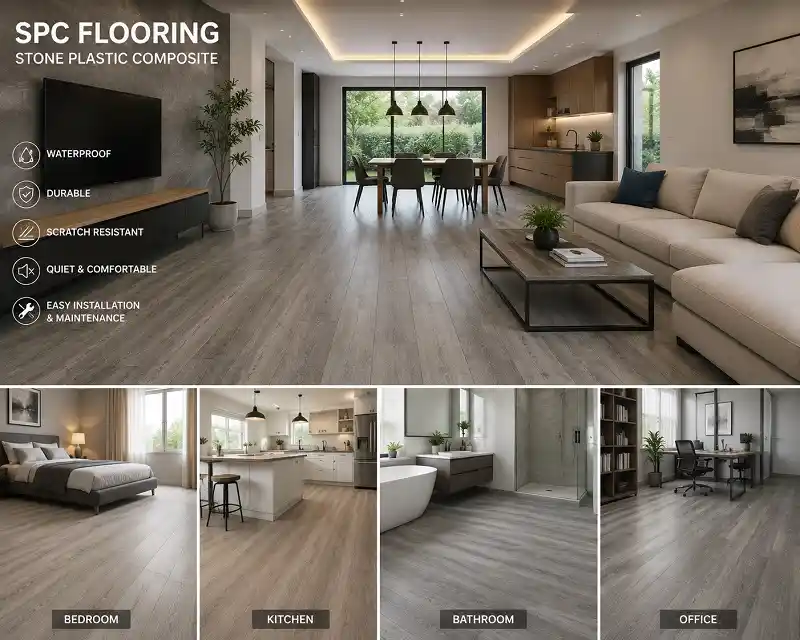
SPC flooring is an advanced type of rigid core vinyl flooring. Its core is made from a mixture of limestone powder and PVC, making it much harder and more stable than standard vinyl or WPC flooring. SPC is one of the newest flooring technologies and offers outstanding durability.
SPC vs. WPC vs. Standard LVP
| Feature | Standard LVP | WPC | SPC |
| Core Material | PVC | Wood plastic composite | Stone plastic composite |
| Hardness | Moderate | Soft | Very Hard |
| Waterproof | Yes | Yes | Yes |
| Dent Resistance | Moderate | Moderate | Excellent |
| Comfort Underfoot | Moderate | Best | Firm |
| Thickness | 4 to 6mm | 6 to 9mm | 4 to 8mm |
| Price | $ | $$ | $$ |
SPC Flooring Cost
| Cost Item | Price Range (per sq ft) |
| Material only | $2 to $6 |
| Installation labor | $1.50 to $3 |
| Fully installed | $3.50 to $9 |
Benefits of SPC Flooring
- 100 percent waterproof
- Extremely hard and dent-resistant
- Dimensionally stable; does not expand or contract much with temperature changes
- Good for areas with underfloor heating
- Click lock installation makes it DIY friendly
- Very realistic wood and stone looks
Best Rooms for SPC Flooring
All rooms, including bathrooms, kitchens, basements, and high-traffic commercial areas.
15. Quick Comparison Table of All Flooring Types
| Flooring Type | Cost per sq ft (installed) | Lifespan | Waterproof | DIY Friendly | Best For |
| Solid Hardwood | $6 to $20 | 50 to 100 yrs | No | No | Living rooms, bedrooms |
| Engineered Wood | $5 to $19 | 20 to 30 yrs | No | Yes | Most rooms, kitchens |
| Laminate | $2 to $10 | 10 to 20 yrs | Partial | Yes | Bedrooms, living rooms |
| Luxury Vinyl (LVP/LVT) | $3 to $11 | 15 to 25 yrs | Yes | Yes | All rooms |
| Ceramic Tile | $5 to $14 | 10 to 20 yrs | Yes | Moderate | Bathrooms, kitchens |
| Porcelain Tile | $7 to $21 | 50+ yrs | Yes | No | Bathrooms, kitchens |
| Natural Stone | $12 to $40+ | 50 to 100 yrs | Partial | No | Entryways, bathrooms |
| Carpet | $2 to $18 | 8 to 15 yrs | No | Yes | Bedrooms, living rooms |
| Bamboo | $4 to $10 | 20 to 30 yrs | Partial | Yes | Living areas |
| Cork | $5 to $12 | 10 to 30 yrs | Partial | Yes | Kitchens, offices |
| Concrete | $0.30 to $20 | 50+ yrs | Yes (sealed) | No | Basements, modern homes |
| Linoleum | $4 to $11 | 20 to 40 yrs | Partial | Moderate | Kitchens, commercial |
| Rubber | $3 to $17 | 20 to 30 yrs | Yes | Yes | Gyms, garages |
| SPC | $3.50 to $9 | 20 to 30 yrs | Yes | Yes | All rooms |
16. Best Flooring by Room
Choosing the right floor for each specific room makes a big difference. Here is a simple room by room guide to help you decide.
Living Room Flooring
The living room sees heavy daily use from foot traffic, furniture, and family activities. It also needs to look good since it is the main space guests see.
Best choices: Hardwood, engineered wood, luxury vinyl plank, high-quality laminate. Why: These options are durable, look great, and are relatively easy to maintain.
Bedroom Flooring
Bedrooms are low-traffic and meant for comfort and relaxation. You walk barefoot here more than anywhere else.
Best choices: Carpet, hardwood, engineered wood, luxury vinyl plank. Why: Carpet is soft and warm underfoot. Hardwood and engineered wood look beautiful and are easy to clean.
Kitchen Flooring
Kitchens deal with water spills, dropped food, heavy appliances, and long hours of standing. You need something waterproof, easy to clean, and comfortable enough to stand on.
Best choices: Luxury vinyl tile, ceramic tile, porcelain tile, cork, linoleum. Why: All of these handle moisture well and are easy to clean.
Bathroom Flooring
Bathrooms are the wettest room in the house. Your floor must handle constant humidity, water splashes, and wet feet.
Best choices: Porcelain tile, ceramic tile, luxury vinyl tile, SPC flooring. Why: These are waterproof or highly water-resistant. Choose textured tile to avoid slipping.
Basement Flooring
Basements often have moisture issues, temperature changes, and are below ground, which means traditional wood floors are risky.
Best choices: Luxury vinyl plank, SPC flooring, tile, epoxy-coated concrete, rubber. Why: All of these handle moisture and temperature changes without warping or growing mold.
Entryway and Mudroom Flooring
Entryways deal with dirt, mud, wet shoes, and the heaviest foot traffic in the home. You need something extremely durable and easy to clean.
Best choices: Porcelain tile, natural stone, luxury vinyl tile. Why: These resist dirt and water, look good, and can be cleaned quickly.
Home Gym Flooring
Home gyms need floors that absorb impact, resist heavy weights, and provide traction.
Best choices: Rubber flooring, vinyl plank, cork. Why: Rubber is the gold standard for gyms. Cork is gentler on joints.
Home Office Flooring
Home offices need quiet, comfortable floors that look professional.
Best choices: Carpet, luxury vinyl plank, cork, hardwood. Why: Carpet and cork reduce noise and feel comfortable during long work days.
17. Flooring and Home Resale Value
The flooring you choose can directly affect how much your home sells for. Here is how different floors rank for return on investment.
| Flooring Type | Impact on Resale Value |
| Solid Hardwood | Highest. Buyers love it. Can increase value up to 147%. |
| Engineered Wood | High. Looks like hardwood and impresses buyers. |
| Porcelain / Ceramic Tile | High in kitchens and bathrooms where expected. |
| Luxury Vinyl Plank | Moderate to High. Increasingly popular with buyers. |
| Laminate | Moderate. Good quality laminate is well received. |
| Carpet | Low to Moderate. Some buyers prefer hard floors. |
| Concrete (polished) | Moderate in modern style homes. |
| Natural Stone | High in luxury market homes. |
Hardwood flooring is widely considered the flooring type with the best resale value. If you are planning to sell your home, installing hardwood in the living room and main areas is one of the best investments you can make.
18. Eco-Friendly Flooring Options
If the environment matters to you when choosing flooring, these options have the lowest environmental impact.
Bamboo: Grows to full size in 3 to 5 years. One of the most renewable flooring materials available.
Cork: Harvested from living trees without cutting them down. The bark grows back in 9 years.
Linoleum: Made entirely from natural, biodegradable materials, including linseed oil and jute.
Reclaimed Hardwood: Old wood salvaged from barns, factories, and demolished buildings. No new trees are cut.
Recycled Rubber: Made from old tires that would otherwise end up in a landfill.
FSC Certified Wood: Look for the Forest Stewardship Council (FSC) certification when buying hardwood or engineered wood, which confirms the wood comes from responsibly managed forests.
19. Flooring for Pets and Kids
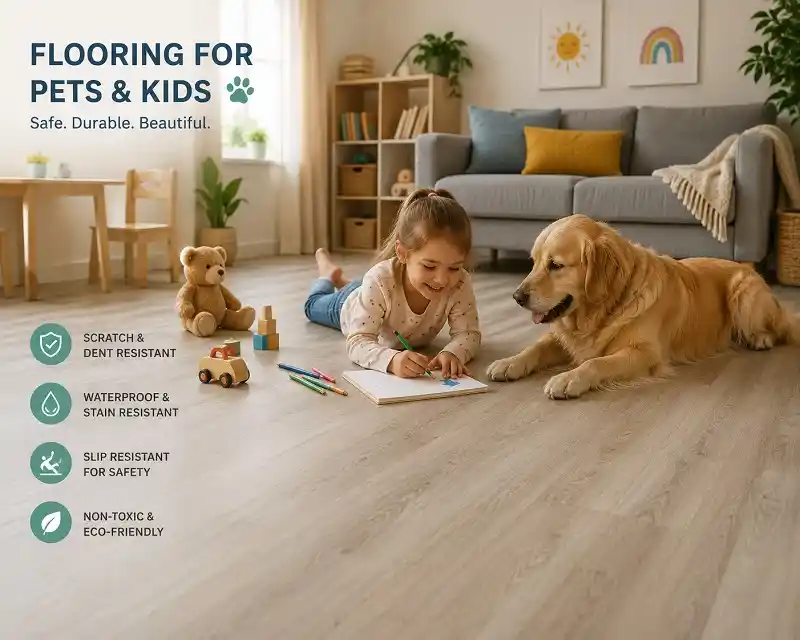
Homes with young children and pets need floors that can take a beating. Here is what to look for and what to avoid.
What to Look For
Scratch resistance: Dogs with claws can quickly scratch soft wood and low-quality laminate. Choose hard tile, SPC, or luxury vinyl for the best scratch resistance.
Water resistance: Kids and pets create spills constantly. Fully waterproof floors like luxury vinyl and tile are the safest choice.
Easy to clean: Smooth hard surface floors are easier to clean than carpet, which traps hair, dander, and bacteria.
Non-toxic: Look for floors with low or zero VOC (volatile organic compound) emissions, especially important for homes with small children who spend time on the floor.
Best Flooring for Pets
- Luxury vinyl plank (scratch and water-resistant)
- Porcelain tile (extremely durable and easy to clean)
- SPC flooring (hardest and most dent-resistant vinyl option)
Best Flooring for Kids
- Carpet (softest; best for falls in bedrooms and playrooms)
- Cork (cushioned and quiet)
- Luxury vinyl plank (waterproof and easy to clean)
Flooring to Avoid with Pets
- Solid hardwood (scratches very easily from claws)
- Polished marble (slippery for animals and humans)
- Low-quality laminate (not waterproof and scratches easily)
20. Common Flooring Mistakes to Avoid
Many homeowners spend a lot of money on flooring and then make simple errors that reduce its life and appearance. Here are the mistakes to watch for.
Skipping the underlayment: Underlayment adds cushion, sound reduction, and moisture protection. Most flooring types need it.
Not measuring waste allowance: Always order 10 percent more flooring than your room measurements. Order 15 percent for diagonal patterns. Running short means waiting weeks for a new batch that may not match perfectly.
Choosing the wrong floor for the room: Using non-waterproof flooring in bathrooms and kitchens is one of the most common and costly mistakes.
Not acclimating the flooring: Wood-based floors need to sit in the room for 48 to 72 hours before installation to adjust to the temperature and humidity. Skipping this leads to gaps or buckling after installation.
Installing over an uneven subfloor: Any bumps or dips in the subfloor will show through your new floor and cause problems over time. Subfloor preparation is just as important as the floor itself.
Ignoring the wear layer thickness: For vinyl and laminate, the wear layer thickness determines durability. For home use, choose at least a 12 mil wear layer. For high traffic areas, 20 mil or more.
Choosing based only on photos: Colors and textures look different in different lighting. Always get a physical sample and look at it in your room at different times of day before buying.
21. Final Thoughts: How to Pick the Right Flooring
There is no single best flooring type for every home or every room. The right choice depends on where you live, how you live, who shares your home, and what you want your floors to look and feel like.
Here is a simple decision process to follow.
Step 1: Identify which room or rooms you are flooring.
Step 2: Determine whether moisture is a concern in that room.
Step 3: Assess how much foot traffic and wear the floor will face.
Step 4: Set a realistic budget that includes material, underlayment, and installation.
Step 5: Decide on the look you want (natural wood, stone, soft carpet, modern concrete).
Step 6: Check long-term maintenance requirements and decide if you can commit to them.
Step 7: Get physical samples and test them in the actual room before ordering.
Following this process will lead you to a floor that you will be happy with for years to come. Flooring is a long-term investment. Taking the time to choose wisely is always worth it.
Frequently Asked Questions About Flooring Types
What is the most durable type of flooring? Porcelain tile and polished concrete are the most durable flooring options. Strand-woven bamboo and SPC vinyl are also among the hardest-wearing options for residential homes.
What is the cheapest type of flooring? Laminate flooring is generally the most affordable option, starting at around $1 per square foot for the material. Sheet vinyl is also very budget-friendly.
What flooring adds the most home value? Solid hardwood flooring consistently adds the most resale value to a home. It is the flooring type most preferred by home buyers.
What is the best waterproof flooring? Porcelain tile, luxury vinyl plank, SPC flooring, and properly sealed concrete are all fully waterproof.
Can you put new flooring over old flooring? In many cases, yes. Vinyl and laminate can often be installed over existing floors if the subfloor is level and in good condition. Tile usually requires the old floor to be removed first.
What flooring is best for underfloor heating? Tile, SPC vinyl, luxury vinyl plank, and engineered wood all work well with radiant underfloor heating. Solid hardwood and carpet are generally not compatible.
How long does flooring installation take? A standard room takes one to three days for most flooring types. Tile takes longer due to drying and curing time for the adhesive and grout.